

M Profile vs V Profile Press Fittings: Which Is Better?
Choosing between M Profile and V Profile press fittings is a common question for engineers, plumbers, mechanical contractors and industrial maintenance teams. Both systems provide fast, reliable and leak-free pipe connections without welding, threading or soldering. However, there are important differences in press jaw compatibility, system availability and the applications they are designed for.
This guide explains the differences between M Profile and V Profile press fittings, how each system works, and why Europress M Profile systems have become a preferred choice for industrial stainless steel pipework throughout Australia.
Quick Answer: Is M Profile or V Profile Better?
Short answer: Neither M Profile nor V Profile is universally better. Both produce strong, leak-free mechanical joints when installed using the correct press tool and approved components. The biggest differences are the pressing profile, compatible press jaws, product availability and manufacturer specifications.
For most industrial stainless steel piping systems in Australia, M Profile press fittings are the preferred choice because they offer excellent availability, a wider product range, compatibility with common M-profile press tools, and proven performance across compressed air, water, gas and process pipework applications.

M Profile vs V Profile at a Glance
| Feature | M Profile | V Profile |
|---|---|---|
| Installation Speed | Excellent | Excellent |
| Leak-Free Performance | Excellent | Excellent |
| Compatible Press Tool | M Profile Jaws | V Profile Jaws |
| Common in Australia | Yes | Less Common |
| Suitable for Stainless Steel | Yes | Yes |
| Suitable for Water Systems | Yes | Yes |
| Suitable for Gas Systems* | Approved products available | Depends on manufacturer approval |
| Suitable for Compressed Air | Yes | Yes |
| Hot Work Required | No | No |
| Installation Method | Mechanical Press Connection | Mechanical Press Connection |
*Always follow the manufacturer's approvals and relevant Australian Standards for gas installations.
What Is an M Profile Press Fitting?
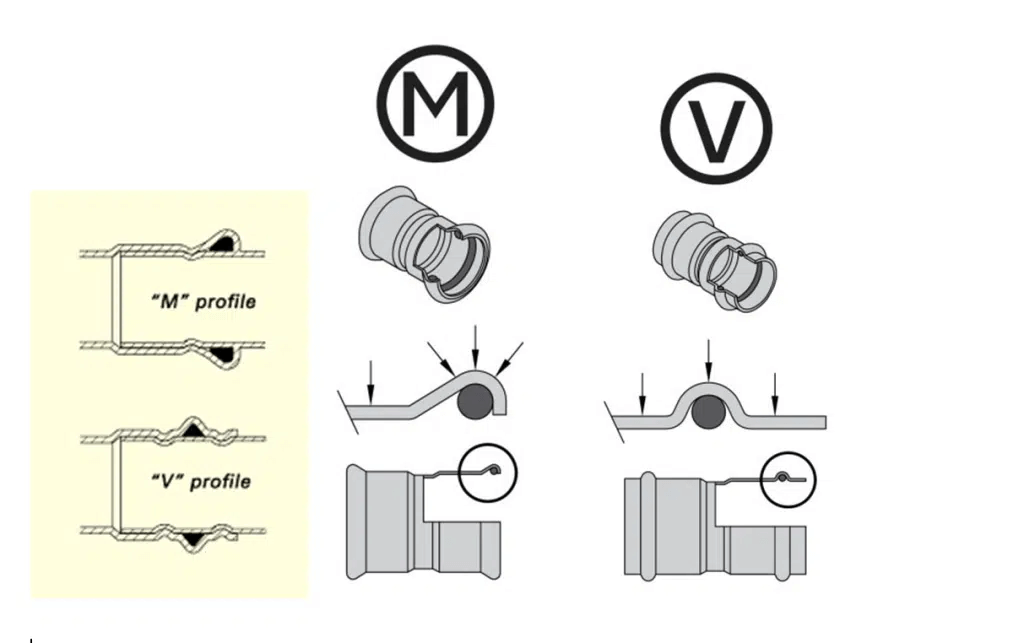
An M Profile press fitting uses a specially designed press contour that creates a permanent mechanical connection around stainless steel or carbon steel pipe. A compatible M Profile press jaw compresses the fitting, permanently deforming the fitting around the pipe while simultaneously compressing the sealing O-ring.
This creates two separate sealing mechanisms:
- Radial compression creates a leak-tight seal around the O-ring.
- Geometric compression permanently locks the fitting onto the pipe.
Europress uses the widely recognised M Profile system because it delivers fast installation, outstanding reliability and compatibility with many industry-standard press tools.
What Is a V Profile Press Fitting?
V Profile press fittings operate using the same overall principle but utilise a different press contour. Although both systems create strong mechanical joints, the pressing geometry differs, meaning V Profile fittings require dedicated V Profile press jaws.
V Profile systems are commonly used in plumbing applications by certain manufacturers but are generally less common in Australian industrial stainless steel installations.
M Profile vs V Profile Press Fittings Comparison
| Comparison | M Profile | V Profile |
|---|---|---|
| Press Jaw Shape | M Contour | V Contour |
| Compatible Press Tool | M Profile only | V Profile only |
| Suitable for Industrial Pipework | Excellent | Good |
| Compressed Air Systems | Excellent | Suitable |
| Stainless Steel Applications | Excellent | Excellent |
| Gas Applications | Approved systems available | Manufacturer dependent |
| Ease of Finding Components | Excellent | Moderate |
| Available Sizes | Wide Range | Manufacturer dependent |
| Maintenance | Minimal | Minimal |
| Installation Speed | Up to 10x faster than welding | Up to 10x faster than welding |
Advantages and Disadvantages
Advantages of M Profile Press Fittings
- Fast installation with no welding or threading.
- Compatible with common M Profile press tools.
- Excellent availability throughout Australia.
- Wide range of stainless steel and carbon steel fittings.
- Suitable for compressed air, water, gas and process piping.
- No hot work permits or naked flames required.
- Reduced labour costs and installation time.
- Reliable, repeatable leak-free joints.
Advantages of V Profile Press Fittings
- Proven press fitting technology.
- Suitable for many commercial plumbing installations.
- Reliable sealing performance when installed correctly.
- Available through selected manufacturers.
Things to Consider
- M and V Profile fittings are not interchangeable.
- Each system requires its own compatible press jaws.
- Always use fittings, pipe and tools recommended by the manufacturer.
- Pressure testing should always be completed before commissioning.
Common Industries Using Press Fittings
Both M Profile and V Profile systems are used throughout industrial and commercial projects where fast, safe and reliable pipe installation is essential.
- Food and beverage manufacturing
- Breweries and wineries
- Pharmaceutical manufacturing
- Hospitals and healthcare facilities
- Mechanical services and HVAC
- Compressed air systems
- Water treatment plants
- Mining operations
- Oil and gas processing
- Manufacturing facilities
- Defence projects
- Educational institutions
Common Press Fitting Installation Mistakes
Even the highest-quality press fitting system relies on correct installation. Avoid these common mistakes to ensure long-term performance.
- Using the wrong press jaw profile.
- Mixing M Profile and V Profile components.
- Failing to deburr the pipe before pressing.
- Damaging or contaminating the O-ring.
- Not inserting the pipe to the correct depth.
- Using incompatible pipe or fittings.
- Skipping pressure testing after installation.
- Using worn or uncalibrated press tools.
Correct installation using approved press tools and genuine fittings ensures reliable, leak-free performance and maximises the service life of the piping system.
Related Press Fitting Resources
If you're planning a new installation or upgrading an existing piping system, these resources can help you choose the right products and equipment for your project.
- Stainless Steel Press Fittings
- Carbon Steel Press Fittings
- Press Tools & Plumbing Press Tools
- Press Fitting O-Rings Guide
- Browse the Europress Product Range
- Read More Technical Articles
Frequently Asked Questions
1. What is the difference between M Profile and V Profile press fittings?
The primary difference is the shape of the press contour. M Profile and V Profile fittings require different press jaws and are generally not interchangeable. Both systems create strong, leak-free mechanical joints when installed correctly.
2. Is M Profile better than V Profile?
Neither profile is inherently better. Both meet high performance standards. M Profile is commonly preferred in Australian industrial applications because of its wide availability, extensive fitting range and compatibility with many industry-standard press tools.
3. Can M Profile and V Profile fittings be used together?
No. M Profile and V Profile fittings should never be mixed within the same joint or installed using the wrong press jaws. Always follow the fitting manufacturer's installation recommendations.
4. Can I use M Profile press jaws on V Profile fittings?
No. Each fitting profile is engineered to work with its matching press jaw. Using the incorrect jaw profile may result in an unsafe or leaking connection.
5. Which press fitting profile is most common in Australia?
M Profile is widely used throughout Australia for industrial stainless steel pipework, compressed air systems, water services and many mechanical services applications.
6. Are M Profile press fittings suitable for compressed air systems?
Yes. Approved M Profile stainless steel press fittings are commonly used in compressed air systems because they provide durable, corrosion-resistant and leak-free pipe connections.
7. Can press fittings be used for gas installations?
Yes, provided the fittings are specifically approved for gas applications and installed in accordance with Australian Standards. Europress offers approved stainless steel gas press fitting systems using yellow HNBR seals.
8. How long do stainless steel press fittings last?
When correctly installed using approved components and press tools, stainless steel press fittings can provide decades of reliable service with minimal maintenance.
9. What industries commonly use press fitting systems?
Press fittings are widely used in food and beverage manufacturing, hospitals, pharmaceutical production, mining, water treatment, HVAC, compressed air systems, defence, oil and gas, and industrial processing plants.
10. Do press fittings require welding or threading?
No. Press fittings create a permanent mechanical connection using a specialised press tool, eliminating the need for welding, soldering or threading.
11. Why do contractors choose Europress M Profile systems?
Europress M Profile systems are chosen for their fast installation, excellent product availability, high-quality stainless steel construction, broad range of fittings and compatibility with common M Profile press tools.
12. How do I choose the right press fitting system?
The best press fitting system depends on your application, operating pressure, pipe material, fluid or gas being transported and relevant Australian Standards. The Air Energy team can help specify the most suitable solution for your project.
Need Help Choosing Between M Profile and V Profile?
Choosing the correct press fitting system can reduce installation time, improve reliability and lower the lifetime cost of your pipework. Whether you're specifying a new compressed air system, mechanical services project, water installation or industrial process line, Air Energy can help you select the right solution.
Our experienced team supplies the complete Europress M Profile press fitting system, including stainless steel pipe, carbon steel pipe, gas-approved press fittings, press tools and accessories for projects across Australia.
Need technical advice? Contact the Air Energy team today on 1300 99 55 26 or browse our complete range of Europress press fittings and accessories.
Related Technical Guides
What is Europress stainless steel press fit pipe
Step By Step: How Europress Press Fit technology works
Frequently asked questions about press fit stainless steel pipe systems
What O-ring materials are used in Europress press fit systems
Four factors that ensure a quality Europress Press Fit Installation
Why Europress Is Trusted in Industrial Piping
- Premium Materials: Engineered in 304 and 316L stainless steel, delivering long-term corrosion resistance for compressed air, water, gas, and process piping systems.
- Certified Press-Fit Technology: Mechanical press connections eliminate welding, sparks, and hot works, providing fast, safe, and reliable installations.
- Industrial Proven: Installed in manufacturing plants, food processing facilities, mining operations, and remote infrastructure where performance cannot be compromised.
- Precision and Reliability: Each fitting uses precision O-ring seals for permanent leak-tight joints, ensuring system integrity under pressure and harsh environments.
- Global Standards Compliance: Europress systems meet DVGW, WRAS, and other international certifications for water and gas applications.
- Manufacturer-Backed Guarantee: 25-year warranty for all Europress approved applications. Press-fit tightness is guaranteed for over 30 years.